You have probably noticed that certain colors make you look alive and well-rested, while others make you look washed out before you have even left the house. That is not random. It is your natural coloring telling you something. A color palette analysis helps you figure out exactly which shades work with your skin tone, hair, and eyes, so you can stop guessing and start dressing with intention. If you want a quick starting point, take our color analysis quiz to discover your season in minutes.
This guide breaks down everything you need to know about finding your colors at home, with no expensive consultation required.


Summer
Cool, soft, and quietly elegant.
Cooler, softer color direction with less contrast.


Winter
Cool, clear, and striking.
Clear contrast, cooler undertones, and stronger saturation.
What Is Color Palette Analysis?
Color palette analysis is a method for identifying which colors complement your natural features. It looks at three things: your skin's undertone, the depth of your natural coloring, and how muted or vivid your features are.
The concept has been around since the 1980s when the book Color Me Beautiful introduced the four-season system. Carole Jackson sorted people into Spring, Summer, Autumn, and Winter based on their natural coloring. The idea was simple: just like the seasons have distinct palettes in nature, people do too.
The system has evolved since then. Modern color analysis often uses a twelve-season model that accounts for more nuance. But the core idea remains the same. When you wear colors that harmonize with your natural features, you look healthier, more put-together, and more vibrant without changing anything else about your appearance.
Think of it this way. The right shade of white near your face can make your skin glow. The wrong shade can emphasize dark circles and make your teeth look yellow. That is the power of understanding your color palette.
How to Find Your Color Season: The Four Seasons Explained
The four-season framework is the simplest way to start your color season analysis. Each season corresponds to a specific combination of undertone and depth.
Spring
Spring coloring is warm and light. If you are a Spring, your skin has golden or peachy undertones. Your hair is typically light to medium, and your eyes are often green, hazel, light brown, or warm blue.
Spring palettes are full of warm, clear, and bright colors. Coral, warm peach, golden yellow, aqua, and ivory all tend to look fantastic. Heavy, dark colors like black or deep burgundy can overpower Spring's lighter features.
Summer
Summer coloring is cool and muted. If you are a Summer, your skin has pink or bluish undertones. Your hair is often ash blonde, light brown, or mousy brown. Your eyes are typically soft blue, grey, grey-green, or cool hazel.
Summers look best in soft, dusty, and muted tones. Lavender, dusty rose, powder blue, soft teal, and mauve are all strong choices. Harsh, warm shades like bright orange or mustard yellow tend to clash with Summer's naturally cool coloring.
Autumn
Autumn coloring is warm and deep. If you are an Autumn, your skin has golden, olive, or warm beige undertones. Your hair is often dark brown, auburn, chestnut, or deep red. Your eyes are typically brown, dark hazel, olive green, or warm dark blue.
Autumns thrive in rich, earthy, and warm tones. Rust, olive, burnt orange, deep teal, mustard, and chocolate brown all work beautifully. Icy pastels and cool-toned brights like fuchsia or icy pink tend to look disconnected from Autumn's warmth.
Winter
Winter coloring is cool and deep. If you are a Winter, your skin has blue, pink, or neutral-cool undertones. Your hair is typically very dark brown or black, and there is strong contrast between your hair and skin.
Winters look striking in bold, high-contrast colors. True red, cobalt blue, emerald green, bright white, and black are all strong choices. Muted, earthy tones like camel, beige, and dusty rose can make Winters look dull because they lack the contrast Winter's features naturally carry.
How to Do a Color Analysis at Home: 3 Simple Tests
You do not need to pay for a professional draping session to get a solid read on your colors. These three at-home tests will point you in the right direction. For a faster answer, you can also find your color season in under two minutes with our free quiz.
The Vein Test
Look at the veins on the inside of your wrist in natural daylight. If your veins appear blue or purple, you likely have cool undertones. If they appear green, you likely have warm undertones. If you see a mix of both, you may be neutral and able to borrow from more than one season.
The White vs. Cream Test
Hold a piece of bright white fabric next to your face, then swap it for an off-white or cream fabric in natural daylight. If bright white makes your skin look clearer, you lean cool. If cream or ivory looks more flattering and makes your skin glow, you lean warm.
The Jewelry Test
Put on a piece of silver jewelry and a piece of gold jewelry, one at a time, and hold each near your face. If silver looks more natural, you lean cool. If gold looks better, you lean warm. If both look equally good, you are likely neutral-toned.
Combined, these three tests give you a strong indication of whether you are warm or cool. From there, consider the depth of your natural coloring to narrow it down further. Light plus warm points toward Spring. Light plus cool points toward Summer. Deep plus warm points toward Autumn. Deep plus cool points toward Winter.
What Colors Look Good on Me? A Breakdown by Season
Once you know your season, here is a practical guide to the specific shades that will work hardest in your wardrobe.
Best Colors for Spring
Warm ivory, peach, salmon, coral, warm pink, golden yellow, light orange, aqua, turquoise, warm light green, camel, and light warm grey. Springs should build their wardrobe around these lighter, warmer tones and save darker shades for accessories.
Best Colors for Summer
Soft white, lavender, dusty rose, mauve, powder blue, periwinkle, soft teal, sage green, light plum, cool taupe, and dove grey. Summers look their best when every piece in the outfit stays within the same softness level.
Best Colors for Autumn
Cream, rust, burnt orange, terracotta, olive green, forest green, mustard, warm red, chocolate brown, deep teal, and warm camel. Autumns can layer richly without looking overdone because the depth and warmth of these shades complement each other naturally.
Best Colors for Winter
Bright white, true red, cobalt blue, emerald green, royal purple, hot pink, black, icy grey, deep navy, and bright turquoise. Winters should lean into high contrast. A Winter wearing head-to-toe beige is leaving one of her best natural advantages on the table.
What Colors Look Good on Brown Skin
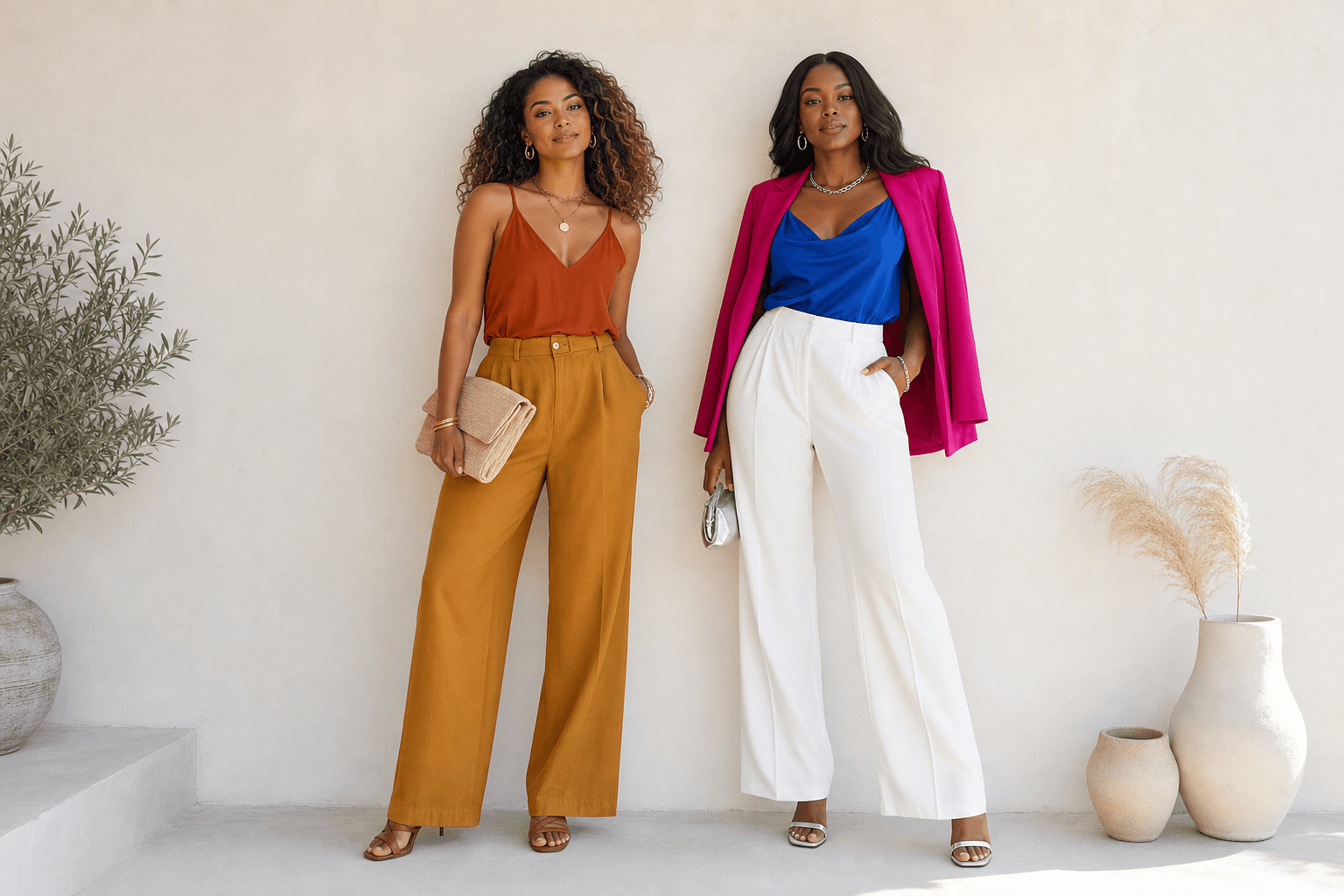
The colors that look good on brown skin usually have enough depth to match the richness of your complexion. These complexions can carry a wide range of color, but the best starting point is undertone, not the old vein test. If you are unsure, take our color analysis quiz and use the result as a first filter.
Traditional color analysis can be too narrow here. Many different brown skin tones have red, golden, or olive undertones that do not fit neatly into the basic warm-or-cool shortcut. It helps to think in terms of hue, value, and chroma, the same three color dimensions used in the Munsell color system. In plain terms: undertone, depth, and saturation all matter.
Warm Brown Skin Tones
Warm undertones often have a golden, honey, or sunlit cast. The best clothing colors for brown skin in this range are rust, terracotta, mustard, camel, burnt orange, olive green, coral, marigold, chocolate brown, cream, and copper. These shades sit close to Deep Autumn and Warm Autumn because they are rich, earthy, and warm. If gold jewelry looks natural on you, this palette is a strong place to start.
Cool Brown Skin Tones
Cool undertones often have red, berry, or rosy undertones. Cobalt blue, emerald green, true red, fuchsia, magenta, royal purple, icy pink, bright white, charcoal, and plum tend to look clear and striking. These colors pull from the Deep Winter family because they are clean, saturated, and high contrast. Silver or rose gold looking better than yellow gold can be a useful clue.
Neutral and Olive Undertones
Neutral and olive undertones often sit between warm and cool, sometimes with a faint green or grey cast. Teal, jade, deep navy, soft red, dusty rose, taupe, slate grey, eggplant, and warm white are usually easier than very pale colors. You can borrow from both warm and cool palettes, but keep the saturation medium to deep. When colors look chalky, go richer instead of lighter.
Light Brown vs. Deep Brown Skin
If you are wondering what colors look good on light brown skin, start with medium-to-deep shades like rust, teal, emerald, berry, navy, and olive. Very pale pink, baby blue, or cream can work, but they need enough contrast so your face does not look washed out.
If you are asking what colors look good on dark brown skin, you can usually handle even stronger contrast. Bright white, pure black, cobalt, emerald, fuchsia, icy lavender, and true red can look beautiful because deeper complexions naturally carry color with strength. The shades to be careful with are muddy mid-tones like khaki, flat beige, and dull taupe, which can reduce your natural contrast.
Colors to Approach with Caution
Across shades of brown skin tones, be careful with colors that are almost the same depth as your skin. Head-to-toe camel on warm brown skin, or head-to-toe chocolate on deeper complexions, can blur the face. If you love those shades, add contrast near your neckline with cream, white, teal, gold, or a clear jewel tone.
Dusty pastels can also be tricky. Sage, soft yellow, and dusty rose may look grey or chalky on some complexions. Cleaner versions, like emerald instead of sage or true rose instead of dusty rose, are usually safer. When in doubt, choose color that is richer, clearer, and more saturated.
How to Build a Wardrobe Around Your Color Palette
Start with your basics. Your everyday tops, t-shirts, and sweaters should be in your best colors. These are the pieces that sit closest to your face and have the most impact on how you look.
Let your season guide your neutrals. Not everyone's neutral is the same. For warm seasons, your best neutrals are cream, camel, warm grey, and olive. For cool seasons, your best neutrals are bright white, cool grey, navy, and black.
Accessories are more flexible. A bag, shoes, or belt can sit outside your palette without affecting how your face looks. Save your boldest or trendiest colors for accessories if they do not fall within your season.
Do not treat your palette as a prison. Color analysis is a guide, not a rulebook. If you love a color that is technically outside your season, wear it. Just keep it farther from your face as a skirt, pants, or bag rather than a top or scarf.
Frequently Asked Questions
Can I do a color analysis on myself?
Yes. The vein test, white vs. cream test, and jewelry test are the most reliable at-home methods. They will not be as precise as a professional draping session, but they give most people a clear direction.
What color season am I if I have olive skin?
Olive skin typically falls into either Autumn or Summer. The key is whether your olive tone has golden warmth or greyish coolness. Many people with olive skin find they are a Soft Autumn or a Soft Summer.
Does your color season change as you age?
Your undertone does not change. But the depth and contrast of your coloring can shift as your hair greys or your skin lightens with age. It is worth reassessing every decade or so.
How is color palette analysis different from a color analysis quiz?
A full color palette analysis evaluates your skin undertone, depth, contrast, and how you look in draped fabrics. A quiz is a simplified version that estimates your season quickly. Quizzes are a great starting point, and a detailed analysis helps you fine-tune from there.
What colors look good on everyone?
True teal, soft blush pink, and medium navy tend to be universally flattering because they balance warm and cool undertones. The specific shade matters, and one will look better on you than another based on your season.
What's the best color for dark brown skin?
Jewel tones like emerald, cobalt, fuchsia, and true red pop against deep brown skin because of the natural contrast. Pure white and pure black also work especially well.
Can someone with brown skin be a Summer or Spring?
Yes, but it is less common than Autumn or Winter. Soft Summer and Soft Autumn are more typical for brown skin with neutral undertones, while very light Spring and Summer palettes can look too pale on deeper complexions.
How do I find my undertone if I can't see my veins?
Skip the vein test. Try the gold-versus-silver jewelry test, or photograph your hand against pure white paper in natural daylight. Yellow or peach reads warm, pink or red reads cool, and green or grey often points to neutral or olive.
Are jewel tones really better than pastels for brown skin?
For most brown skin, yes. Jewel tones match the natural depth and richness of the skin. Pastels can still work, especially on deep brown skin, but clean icy pastels usually flatter more than dusty or chalky pastels.
Final Step
Get a faster starting point before you shop.
If you want help narrowing down your season without second-guessing every test result, take our free color analysis quiz. It is a simple way to get moving before you start building a wardrobe around your best colors.